
Victory's Curse: How America Keeps Fighting Wars It's Already Won
America has a documented talent for achieving military objectives and then forgetting what they were. Time after time, U.S. forces accomplish their stated mission only to discover that success has become the starting point for an entirely different conflict. The pattern is so consistent that military historians have a term for it: "mission creep." But the real problem isn't that missions expand — it's that victory becomes politically unrecognizable.
The Korean Template
The Korean War established the template for everything that followed. President Truman's initial objective was clear: repel North Korean forces and restore the 38th parallel as the boundary between North and South Korea. By October 1950, UN forces had achieved this goal completely. North Korean forces were routed, Seoul was liberated, and the original border was restored.
Then General MacArthur convinced Washington to pursue a new objective: unify Korea under South Korean control. This mission expansion transformed a successful defensive operation into a disastrous offensive campaign that brought China into the war and led to three more years of fighting.
 Photo: General MacArthur, via c8.alamy.com
The crucial moment came when Truman had to choose between declaring victory and accepting expanded objectives. Political pressure favored expansion. Military success had created momentum for broader goals, and stopping at the original objective looked like lack of ambition rather than strategic wisdom.
General Omar Bradley, Chairman of the Joint Chiefs, later called the expanded Korean campaign "the wrong war, at the wrong place, at the wrong time, and with the wrong enemy." But Bradley's assessment came after the political window for stopping at success had already closed.
The Domestic Politics of Continuation
The Korean pattern reveals a fundamental asymmetry in American war-making: starting wars requires convincing Congress and the public that military action is necessary, but stopping wars requires convincing them that limited objectives are sufficient. The first argument appeals to American confidence and optimism. The second sounds like defeatism.
This dynamic reflects deeper currents in American political culture. Success generates expectations for greater success. Military victory becomes evidence that more ambitious goals are achievable. The president who stops at limited objectives faces accusations of thinking too small, lacking vision, or failing to capitalize on American advantages.
Consider the political incentives facing any president whose military forces have just achieved their stated objectives. Declaring victory and bringing troops home requires defending why the original goals were sufficient. Expanding objectives and continuing operations requires only arguing that America should pursue all possible advantages.
The first choice demands complex explanations about strategic restraint and limited war aims. The second choice offers simple narratives about American power and unlimited possibilities. In a political system that rewards clear messages over nuanced analysis, the choice becomes obvious.
Vietnam's Escalation Ladder
Vietnam demonstrated how these incentives operate over extended periods. American involvement began with limited advisory missions to help South Vietnamese forces resist communist insurgency. Each escalation step seemed logical given previous commitments, but the cumulative effect was a massive war that bore no resemblance to original objectives.
By 1965, the United States had achieved its initial goal of preventing immediate South Vietnamese collapse. The government in Saigon was stable, the military was functional, and communist forces were contained. But instead of declaring success, Washington redefined the mission: defeat the Viet Cong, stop North Vietnamese infiltration, and create a permanent non-communist South Vietnam.
General Matthew Ridgway, who had commanded UN forces in Korea, warned against this expansion. He argued that limited objectives were achievable but that broader goals would require indefinite commitment with uncertain outcomes. His warnings were ignored because they conflicted with the political momentum that military success had generated.
The result was eight more years of fighting that accomplished nothing beyond the original 1965 objectives. The Paris Peace Accords of 1973 essentially restored the military situation that had existed when major escalation began. The intervening years of combat had changed nothing except the casualty count.
The Afghanistan Paradox
Afghanistan provided the clearest modern example of victory becoming indistinguishable from stalemate. The initial objective was specific and achievable: destroy Al-Qaeda's operational capacity and remove the Taliban government that harbored them. By early 2002, both goals had been accomplished.
Al-Qaeda's training camps were destroyed, its leadership was dead or scattered, and its operational capacity was eliminated. The Taliban government had collapsed, and its leaders had fled to Pakistan. The mission that justified invasion had been completed.
But success created pressure for broader objectives. Military commanders argued that withdrawal would allow Taliban resurgence. Intelligence agencies warned that Al-Qaeda could reconstitute if Afghanistan remained unstable. Humanitarian advocates demanded long-term commitment to Afghan development and women's rights.
Each argument was reasonable in isolation, but collectively they transformed a limited counterterrorism operation into an indefinite nation-building project. The original mission disappeared beneath layers of expanded objectives that had never been part of the initial justification for war.
General Stanley McChrystal, who commanded U.S. forces in Afghanistan from 2009 to 2010, later acknowledged this dynamic: "We achieved our initial objectives quickly, but then we convinced ourselves that we needed to achieve objectives we had never articulated when the war began."
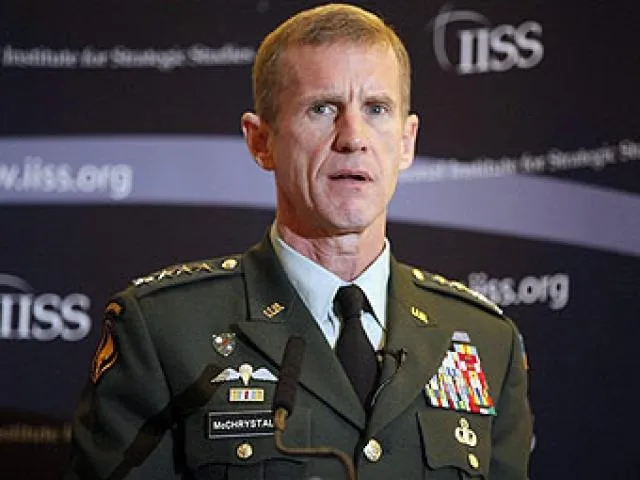 Photo: General Stanley McChrystal, via biographs.org
The Generals Who Get Fired
America has a consistent pattern of removing military leaders who advocate stopping at success. MacArthur was fired for publicly opposing Truman's decision to limit Korean War objectives — but only after he had successfully lobbied for the mission expansion that made the war unwinnable. Ridgway was marginalized for questioning Vietnam escalation. McChrystal was dismissed for criticizing the Afghanistan strategy he had been ordered to implement.
These firings reflect the impossible position that military leaders face once political momentum favors mission expansion. They can advocate for broader objectives and risk military disaster, or they can counsel restraint and risk political destruction. The incentive structure systematically punishes generals who recognize victory and rewards those who promise greater victories ahead.
This pattern explains why accurate military advice becomes unavailable precisely when it's most needed. The generals who understand that limited objectives have been achieved are removed from positions where they can influence policy. The generals who remain are those willing to pursue expanded objectives regardless of military feasibility.
The result is a systematic bias toward continuation over conclusion, expansion over consolidation, and political optimism over military realism. The institutional memory of what constitutes success gets lost in the political pressure to achieve ever-greater successes.
The Long Game's Verdict
American military history reveals a consistent inability to stop fighting after winning. The pattern transcends party politics, individual leadership, and specific conflicts. It reflects structural features of American political culture that make limited objectives seem insufficient and strategic restraint appear weak.
The tragedy isn't that America loses wars — it's that America keeps fighting wars it has already won until victory becomes indistinguishable from defeat. The political machinery that makes starting wars relatively easy makes stopping them nearly impossible, even when continued fighting serves no identifiable purpose.
This dynamic will persist until American political culture develops frameworks for recognizing and celebrating limited success. Until then, victory will continue to be the enemy of victory, and the generals who point this out will continue to be fired for telling truths that political systems cannot accommodate.
The long game suggests that America's next war will follow the same pattern: initial success, mission expansion, indefinite continuation, and eventual withdrawal that accomplishes nothing beyond what was achieved in the first year. The only variable is whether anyone will remember this prediction when it happens.