The Invisible Election: How Line-Drawing Became the Only Contest That Counts
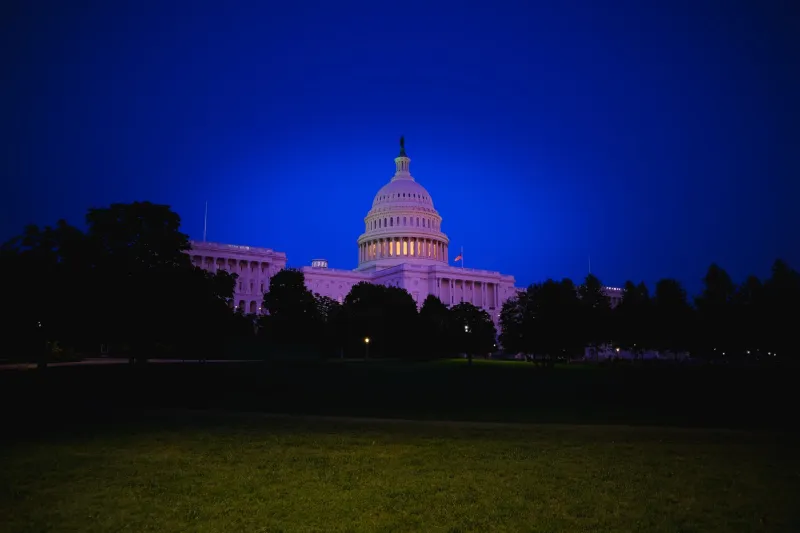
Elbridge Gerry did not invent the practice. He merely lent it his name, and his name became a verb, and the verb became so embedded in American political vocabulary that most citizens now use it without knowing they are invoking a Massachusetts governor who died in 1814. The salamander-shaped district that inspired the term was, by contemporary standards, an almost artless creation — a crude geographic contortion designed to concentrate opposition voters in a single district and dilute them everywhere else.
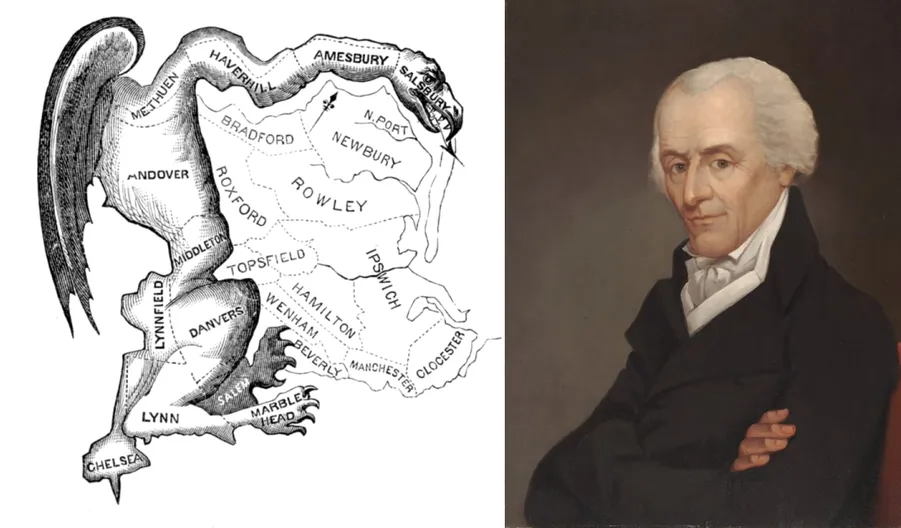 Photo: Elbridge Gerry, via newenglandhistoricalsociety.com
Two centuries later, the same maneuver is executed by algorithms processing census data at a granularity Gerry could not have imagined, producing district maps that achieve with mathematical precision what his cartographers accomplished by rough approximation. The goal is identical. The sophistication is not.
What has changed most profoundly between Gerry's era and our own is not the technique. It is the stakes. In 1812, a manipulated district was a local political embarrassment. In the twenty-first century, the decennial redistricting process determines the effective composition of Congress for a decade at a time, often before the decade's first general election has been held.
The Map Precedes the Vote
To understand how redistricting became the dominant event in American electoral politics, it is necessary to understand what district lines actually determine. In a winner-take-all, single-member-district system — which is what the United States operates — the geographic distribution of voters is not a neutral fact. It is a political variable that can be manipulated to produce predetermined outcomes.
The technical literature on this subject is extensive and largely unread by the public it most directly affects. What it demonstrates, in aggregate, is that a sufficiently skilled cartographer working with accurate voter data can construct a map in which the majority of districts favor one party even when the overall voter population is evenly divided — or even when the majority of voters statewide prefer the other party. This is not a theoretical possibility. It has been demonstrated empirically, in multiple states, across multiple redistricting cycles.
The implication is significant. In these districts, the general election is not the decisive contest. The decisive contest is the map-drawing process that preceded it by months or years. The November election ratifies a decision that was already made in a legislative chamber, a governor's office, or — in states where the process has been partially reformed — a commission room where the composition of the commission itself was determined by the same partisan actors nominally excluded from direct line-drawing.
The Historical Arc
The history of American redistricting is, at its core, a history of escalating sophistication applied to an unchanging objective. The psychological constants here are elementary: actors with the power to shape the rules of competition will shape them in their own favor. This observation requires no cynicism — it is simply a description of how rational actors behave when given the opportunity, as the historical record across every political system that has ever existed amply confirms.
What is specific to the American experience is the particular interaction between this universal tendency and a constitutional framework that vests redistricting authority primarily in state legislatures — the very bodies whose members are most directly affected by where the lines fall. The founders, who spent considerable energy designing against concentrated power, left this particular concentration largely unaddressed, in part because the census mechanism was new, the implications were not yet fully visible, and the political technology required to exploit them did not yet exist.
By the mid-twentieth century, the exploitation had become sufficiently egregious that the Supreme Court felt compelled to intervene. The reapportionment revolution of the 1960s — Baker v. Carr, Reynolds v. Sims, the one-person-one-vote principle — represented the judiciary's most direct engagement with redistricting, and it resolved the grossest population disparities between districts. It did not resolve, and perhaps could not resolve, the partisan manipulation of district shapes within population-equal maps.
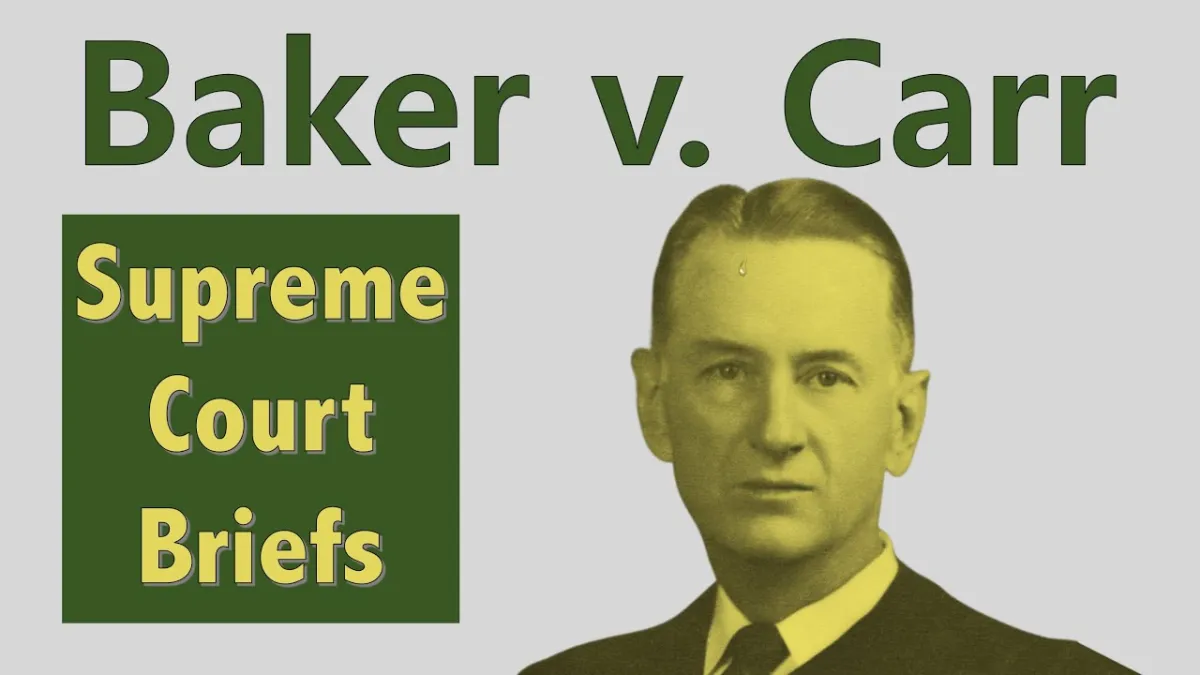 Photo: Baker v. Carr, via i.ytimg.com
The decades that followed produced a gradual but decisive escalation. As computing power increased, as voter data became more granular, and as the political consequences of decennial redistricting became more clearly understood by both parties, the resources devoted to controlling the process increased proportionally. By the 1990s, redistricting had become a recognized strategic priority, with both national parties investing in state legislative races specifically because state legislatures controlled post-census map-drawing. The map had become the prize. The election was the means of winning it.
The Algorithmic Turn
The arrival of sophisticated mapping software completed the transformation that Gerry's cartographers had only begun. Where earlier gerrymanders were constrained by the imprecision of manual calculation — a district could be made favorable, but not with great exactitude — modern computational redistricting allows practitioners to optimize maps across thousands of variables simultaneously, producing configurations that maximize partisan advantage while satisfying legal requirements for compactness, contiguity, and minority representation.
This precision has two effects that compound each other. First, it makes the resulting maps more durable — harder to challenge legally, harder to reverse electorally. Second, it makes the maps less visible to the public, because the manipulation is embedded in data rather than expressed in obviously absurd shapes. The modern gerrymander does not look like a salamander. It looks like a reasonable approximation of county lines, which is precisely the point.
The legal landscape has evolved to accommodate this opacity. The Supreme Court's 2019 ruling in Rucho v. Common Cause held that federal courts could not adjudicate partisan gerrymandering claims — a decision that effectively removed the most powerful check on the practice and returned the question to state courts and state law, producing a fragmented national picture in which the permissibility of any given map depends heavily on which state drew it.
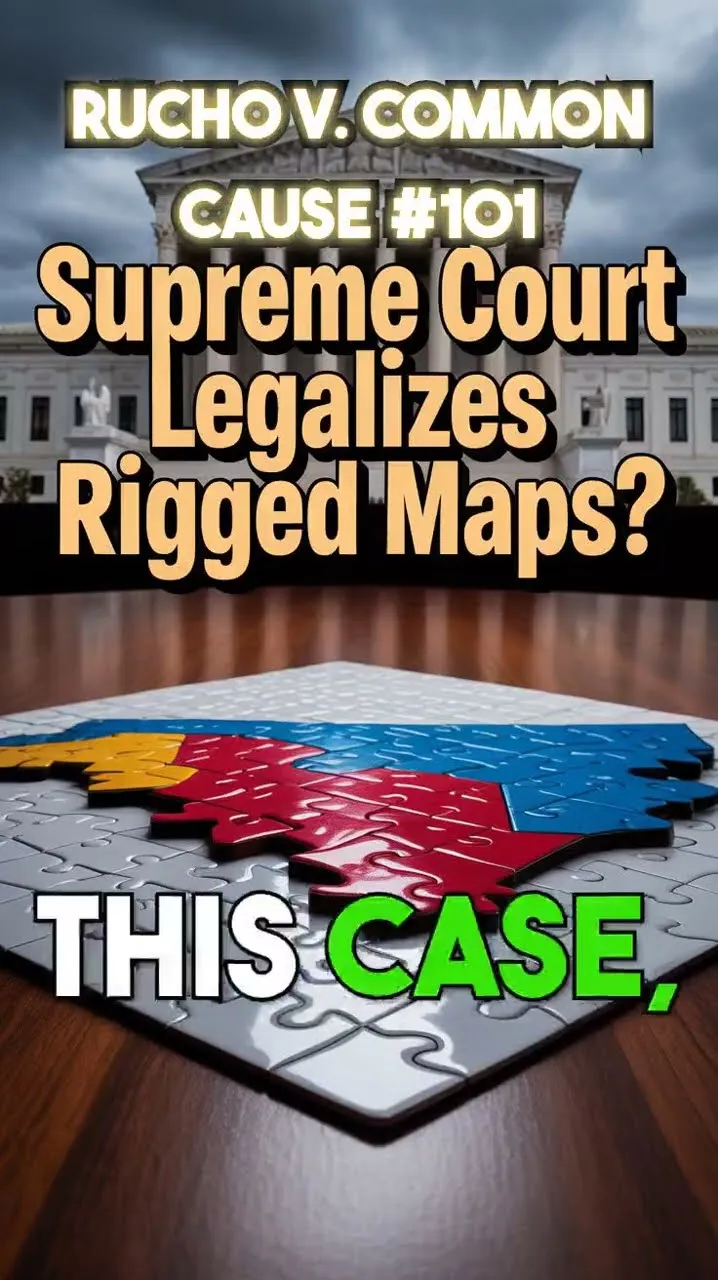 Photo: Rucho v. Common Cause, via i.ytimg.com
The Democracy That Decides Before It Votes
The long-term consequence of this trajectory is a representative system in which the outcome of most congressional elections is determined not by the preferences of the general electorate but by the preferences of whichever party controlled the relevant state legislature in the census year. This is not a polemical characterization — it is a structural description that applies to maps drawn by both parties, and has been documented extensively by political scientists who hold a range of ideological commitments.
What the historical arc of redistricting reveals is a familiar pattern: a procedural mechanism designed for administrative neutrality, captured by partisan actors, refined over generations into an instrument of durable advantage, and ultimately normalized to the point where its most consequential features are largely invisible to the electorate it shapes.
The voters who enter polling booths in November are, in the majority of congressional districts, participating in a ceremony. The election that determined their representation was held in a room they were not invited into, conducted by officials they did not directly select, and concluded before most of them were paying attention.
In the long game of American democracy, the map has consistently outrun the territory. The territory, for the most part, has not noticed.