The Weapon Nobody Wants to Use and Everybody Keeps Improving: A Century of Debt Ceiling Brinkmanship
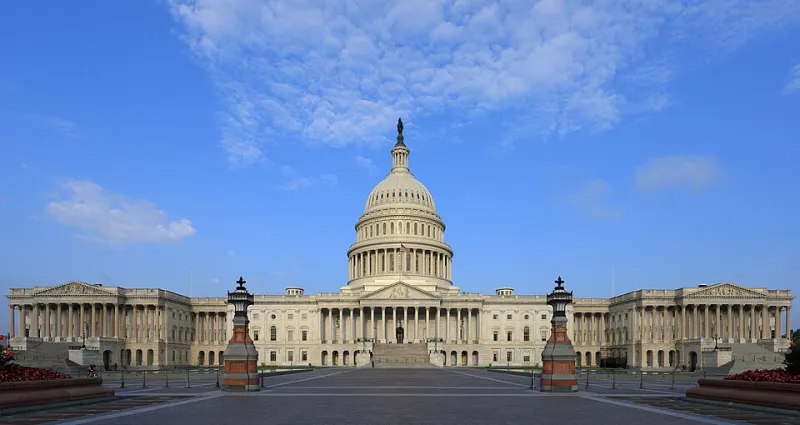
Photo: Martin Falbisoner, CC BY-SA 3.0, via Wikimedia Commons
The United States debt ceiling was created in 1917 as a bureaucratic convenience. Before its introduction, Congress had to authorize each individual bond issuance separately — a cumbersome process that the demands of World War I financing made impractical. The ceiling was designed to give the Treasury Department operational flexibility while maintaining nominal congressional oversight. It was, in the language of its creators, an administrative instrument. Nobody described it as a weapon. Nobody needed to. The weapon had to be discovered, and that discovery has been ongoing, in iterative cycles, for more than a century.
The Mechanism Was Always Vulnerable to Itself
To understand what the debt ceiling has become, it is useful to understand what it was always structurally capable of becoming. The mechanism creates a hard numerical limit on the federal government's borrowing authority. That limit can only be raised by a legislative majority. Any minority capable of blocking that majority therefore holds, in theory, the capacity to trigger a default on obligations that Congress has already voted to incur. This is not an obscure legal interpretation. It is the straightforward operational logic of the instrument, and it was apparent to careful observers essentially from the moment of the ceiling's creation.
What was not apparent — what could not be apparent in 1917 — was how the political incentive structure surrounding this logic would evolve over a century of partisan polarization, media transformation, and the gradual erosion of the institutional norms that had historically constrained its use.
The early decades of the ceiling's existence saw routine increases with minimal drama. This was not because legislators were more responsible or more patriotic. It was because the political cost-benefit calculation of threatening default was, in that environment, obviously unfavorable. The minority that blocked a debt ceiling increase would bear clear and immediate responsibility for the resulting crisis. The political cost of that responsibility was prohibitive. The weapon existed, but the conditions that would make it attractive to deploy had not yet developed.
How Brinkmanship Learns to Walk
The transformation began gradually and then accelerated. Each confrontation that ended in a last-minute resolution taught both sides a specific and dangerous lesson: the other party will concede before the actual threshold is crossed. This lesson, repeated across cycles spanning decades, produced a behavioral pattern that game theorists would recognize immediately and that historians of diplomacy have documented in contexts ranging from nuclear standoffs to labor negotiations to imperial boundary disputes.
When both parties to a confrontation believe the other will blink first, each party has an incentive to hold out longer than the previous cycle. Each successful resolution — each instance in which the ceiling was raised after a period of manufactured crisis — validated the strategy of the party that had extracted concessions and encouraged the party that had conceded to seek a more favorable position in the next cycle. The brinkmanship did not remain static. It escalated, incrementally, in ways that were invisible within any single cycle but unmistakable across the full historical arc.
The 1995-1996 confrontation between the Gingrich-led House and the Clinton White House represented a meaningful escalation over previous standoffs. The 2011 confrontation between the Boehner-led House and the Obama administration escalated further still — sufficiently that the United States' credit rating was downgraded by Standard & Poor's for the first time in history, not because a default occurred but because the credibility of the commitment to avoid one had been visibly compromised. The 2023 confrontation pushed the timeline closer to the actual X-date than any previous episode. Each cycle ended without catastrophe. Each cycle ended at a point that would have been considered catastrophically reckless by the participants of the cycle before it.
 Photo: Standard & Poor's, via img.favpng.com
The Systematic Erasure of Institutional Memory
What makes this escalation pattern particularly durable is the mechanism by which institutional memory is erased and rewritten between cycles. Legislative turnover ensures that the participants in each confrontation are not, in large part, the participants from the previous one. The legislators who lived through the 2011 episode — who understood, in a visceral rather than abstract way, how close the system came to a genuine breach — have been replaced, in significant numbers, by legislators for whom 2011 is history rather than experience.
This is not a new problem. The Roman Senate of the late Republic repeatedly confronted constitutional crises that earlier generations of senators had navigated successfully, and repeatedly found that the precedents established by those earlier navigations had been stripped of the contextual memory that made them meaningful. What remained was the formal record of what had been done, without the informal understanding of why certain lines had been treated as uncrossable. The formal record, absent that understanding, became a manual for escalation rather than a constraint upon it.
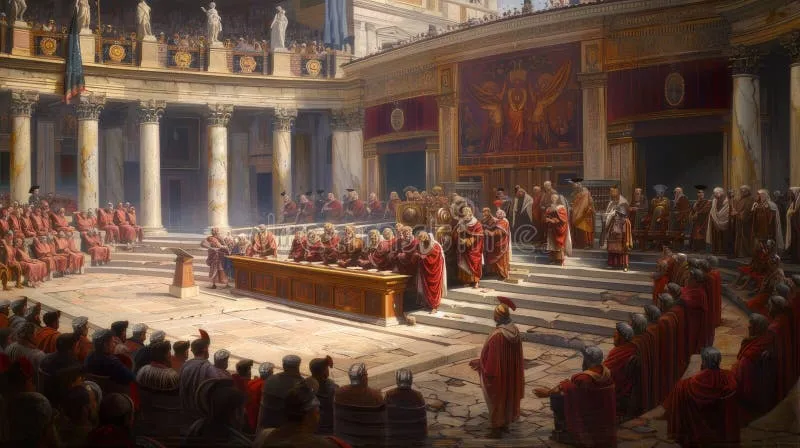 Photo: Roman Senate, via thumbs.dreamstime.com
The debt ceiling operates similarly. Each generation of legislators inherits the instrument, inherits the record of previous confrontations, and inherits the lesson that previous confrontations resolved without catastrophe. What they do not inherit — what cannot be transmitted through the formal record — is the experiential understanding of how contingent those resolutions were. They learn that the gun was pointed and not fired. They do not learn how close the finger came to the trigger.
The Asymmetry That Makes the Next Crisis Worse
There is an additional dynamic that the theatrical framing — press as alarmist, historians as dismissive — consistently obscures. Each cycle of brinkmanship does not simply raise the threshold for the next confrontation. It also changes the population of legislators who are willing to approach that threshold. Politicians who regard the debt ceiling as a genuinely dangerous instrument tend, over time, to either moderate their use of it or exit the arena. Politicians who regard it as a cost-free negotiating lever tend to seek positions from which they can deploy it more effectively. The selection effect, operating across multiple cycles, gradually tilts the composition of the relevant caucuses toward the latter group.
This is the structural feature that neither the press's crisis framing nor the historian's theatrical framing captures adequately. The danger is not that a single confrontation will accidentally produce a default. The danger is that the population of decision-makers who believe a default is genuinely unthinkable is shrinking — not because the consequences have changed, but because the people who remember what those consequences looked like in practice are no longer in the room.
The weapon was never supposed to be loaded. Each generation that picks it up and sets it down without incident becomes slightly more confident that the loading was always just for show. History, characteristically, is patient about correcting that kind of confidence. It simply waits for the generation that is wrong.